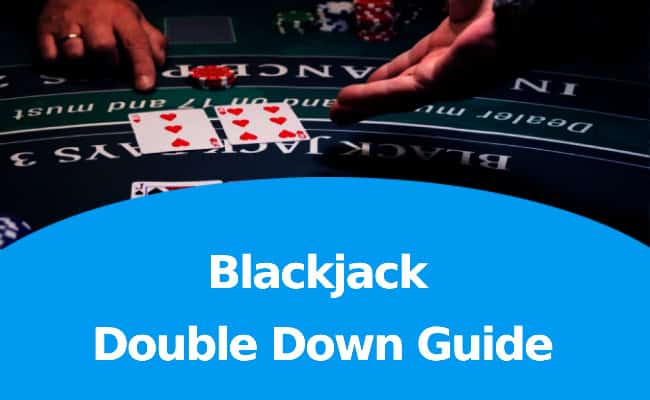
This blackjack double down guide explains why doubling can be mathematically favourable in selected situations, while still exposing you to a larger single-hand loss. Both halves of that sentence matter.
Doubling is a basic strategy decision. It isn’t a way to recover a losing run, and it certainly isn’t a shortcut to bigger profits. Used correctly it improves the expected value of specific hands. Used because the last hand went badly, it just puts twice as much on the table.
What does double down mean in blackjack?
Double down lets you double your original stake after seeing your first two cards while playing online blackjack. In return, you receive exactly one additional card and the hand closes automatically. No further hits, no stand decision, no changing your mind.
How double down works in practice
A beginner asking how does double down work blackjack should first understand that the extra stake buys exactly one additional card. Here’s the sequence:
- Opening stake: £5.
- Your first two cards: a 6 and a 5, giving hard 11.
- The dealer shows a 6.
- You select Double Down and add another £5.
- Total stake on the hand: £10.
- One card arrives. A ten gives you 21. A two leaves you on 13, and the dealer then completes their hand.
That’s the whole mechanic. What decides whether it’s the right call isn’t a feeling — it’s the interaction between four things: your chance of improving with one card, the dealer’s likelihood of making a strong hand or busting, the strength of your starting total, and the rules of that particular table.
How table rules change the double down decision
Doubling is permitted after the first two cards in most variants, but the conditions vary. Check the Game Rules, Help or Paytable screen before you sit down at any table in our casino.
| Table rule | What it means | Effect on strategy |
| Double on any two cards | You can double on any starting total | More opportunities available; generally the friendlier setup |
| Double only on 9–11 | Doubling restricted to hard 9, 10 or 11 | Removes decisions, particularly on soft hands |
| DAS (Double After Split) | You may double after splitting a pair | A rule that works in the player’s favour |
| No DAS | No doubling once you’ve split | Reduces the value of certain splits |
| One-card double | A single card follows the double | This is the standard format |
| Double for less | Increase the stake without matching it fully | Lowers exposure, but changes the maths behind a full double |
Doubling only makes sense when that extra card carries enough expected value to justify risking twice the stake. Which is why it’s most often correct against weak dealer upcards — roughly 2 through 6, where the dealer is more likely to have to draw and bust.
When to double on hard totals
The guidance below is a working summary of basic strategy for a common multi-deck game. Adapt it if the dealer hits soft 17, if surrender is offered, if doubling is restricted, or if the variant uses non-standard rules.
| Your hand | Dealer upcard | Typical decision |
| Hard 11 | 2–10 | Double |
| Hard 10 | 2–9 | Double |
| Hard 9 | 3–6 | Double |
| Hard 8 or below | Any | Hit — don’t double |
| Hard 12–16 | 2–6 | Usually stand, not double |
| Hard 12–16 | 7 through ace | Usually hit, or surrender where available — not double |
| Hard 17+ | Any | Stand |
Hard 11 against a dealer 6 is the clearest case in the game. You can’t bust with one card, you’ve a strong chance of landing somewhere between 18 and 21, and the dealer is stuck showing a card that forces them to draw from a weak position.
When to double on soft totals
A soft hand holds an ace counted as 11 — ace plus 6 is soft 17. The ace can drop to 1 after you draw, which gives you protection against busting.
| Soft hand | Dealer upcard | Typical decision |
| A,2 or A,3 | 5–6 | Double if allowed; otherwise hit |
| A,4 or A,5 | 4–6 | Double if allowed; otherwise hit |
| A,6 | 3–6 | Double if allowed; otherwise hit |
| A,7 | 3–6 | Double. Against 2, 7 or 8 often stand; against 9 through ace, hit |
| A,8 or A,9 | Any | Stand |
Soft hands are where most avoidable errors happen. Soft 17 feels like a decent total, so standing seems sensible — but against a weak dealer card it usually isn’t strong enough to hold, and doubling can carry the better expected value.
Understanding when to double down in blackjack means comparing both your two-card total and the dealer’s visible card, rather than doubling only because your own hand looks promising. Those are two different judgements, and only one of them is complete.
Double after split: what DAS means
With pairs, the first question is split, hit or stand. Doubling only enters the picture afterwards, and only where the table permits DAS.
| Pair | Base decision | What DAS changes |
| A,A | Split | You normally can’t double after splitting aces |
| 8,8 | Split | DAS can open up doubling on the resulting hands |
| 2,2 or 3,3 | Split against roughly 2–7, rules depending | DAS makes the split more attractive |
| 4,4 | Split only in specific conditions, often with DAS against 5–6 | Without DAS, usually played as hard 8 |
| 5,5 | Never split — treat as hard 10 | Double against 2–9 |
| 9,9 | Split in many situations | Post-split doubling depends on the new hand |
| 10,10 | Stand | Don’t split, don’t double |
One thing to be careful about: DAS is not available everywhere. The table has to state it in the rules. If you can’t find it, assume doubling after a split isn’t permitted.
Common double down mistakes
Basic strategy isn’t universal, and that’s the root of several of these. A chart built for a six-deck game with the dealer standing on soft 17 and DAS available won’t map cleanly onto an RNG variant that restricts doubling to 9–11.
Before using any chart, confirm:
- Number of decks.
- Blackjack paying 3:2 or 6:5.
- Dealer standing or hitting on soft 17.
- Doubling on any two cards, or only 9–11.
- DAS available or not.
- Surrender available or not.
- Rules after splitting aces.
- Minimum, maximum and table limits.
The errors that cost players most:
- Doubling on hard 12–16 because the dealer shows a low card. In most of these hands the correct play is to stand.
- Doubling against a dealer 9, 10 or ace outside the specific situations basic strategy allows for.
- Treating soft hands like hard ones. A,6 is soft 17 — it can be played as 7 or 17 — while 7,6 is a hard 13 only, but they play completely differently.
- Using a classic blackjack chart on a variant with different rules.
- Doubling after a loss to recover the bankroll. This is the one to watch for.
- Staking too high without accounting for the fact that a double exposes twice the planned amount.
- Assuming side bets or insurance improve alongside it. They’re separate markets and doubling does nothing for them.
A sound double down strategy blackjack approach follows the game’s rules and the correct basic strategy chart; it is not a progressive betting system. The moment it becomes a response to how the last few hands went, it’s stopped being strategy.
Bankroll management and responsible play
Doubling raises variance. A correct decision can still lose — and when it does, it costs twice your opening stake. So plan the bankroll knowing some hands will need two units rather than one.
- Set a base stake that lets you absorb doubles without breaking your session deposit limit.
- Count a double as two units of risk, not one hand.
- Don’t scale doubles up or down to chase a run.
- Don’t follow a lost hand with a bigger stake on the next one.
- Take a break if frustration is shaping your decisions.
Our responsible gaming page covers deposit limits, reality checks, time-outs and self-exclusion, all of which are available in your account settings. The National Gambling Helpline runs 24 hours a day on 0808 8020 133.
Double down improves expected value, not certainty
The best hands to double down are not simply the highest totals: they’re the hands where one card and the dealer’s upcard combine into the strongest expected-value situation. Hard 11 against a 6 qualifies. Hard 15 against a 5 does not, however tempting the dealer’s weak card looks.
Doubling correctly improves your position over a very long run of hands. It doesn’t guarantee a win, and it doesn’t erase the house edge. In regulated RNG games, outcomes must be acceptably random — so no sequence of previous hands makes a double a safe bet.
Play for entertainment, within a deposit limit you’ve set beforehand, and stop when it stops being enjoyable.
FAQs
Can I double down on any hand?
It depends on the table. Some allow it on any two cards; others restrict it to hard 9, 10 or 11. Check the rules screen first.
Do I always get just one card?
Yes, in the standard format. The hand closes as soon as that card lands.
Should I double against a dealer ace?
Generally no. Basic strategy calls for doubling against strong upcards only in narrow, specific situations.
What is “double for less”?
Some tables let you add less than your full original stake. It reduces exposure, though it also changes the maths that made the double correct in the first place.
Where do I find the rules at Betnero UK?
In each game’s info or rules screen. The full table selection and our sportsbook are reachable from the Betnero homepage.
Gambling is strictly for players aged 18 and over. Please gamble responsibly. For support and more information, visit GamCare.org.uk or call the free, 24/7 National Gambling Helpline on 0808 8020 133.